
In the previous article, Norrøn Voyages lost its website to an outdated plugin, on a flat network with shared passwords. Before touching anything, here is where I want to go — and in what order.
The target#
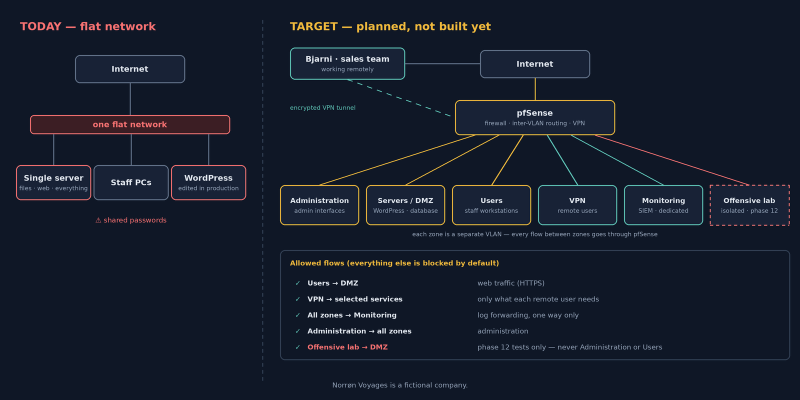
The target is a segmented network: each zone is a separate VLAN, and every flow between zones goes through the pfSense firewall. Everything is blocked by default; each flow is opened explicitly, for a reason.
- Administration: the admin interfaces of Proxmox and pfSense are only reachable from here;
- Servers / DMZ: the WordPress site and its database, the only part exposed to the Internet;
- Users: the staff’s workstations, which reach the website like any visitor;
- VPN: Bjarni and the sales team connect through the Internet; their encrypted tunnel ends on pfSense, which only lets them reach the services they actually need;
- Monitoring / SIEM: in its own VLAN. Logs from every zone arrive one way only, so that an attacker who compromises a server can’t reach the SIEM to erase their tracks;
- Offensive lab: an isolated attack machine for the final phase. It may reach the DMZ during the phase 12 tests, never the Administration or Users zones.
This is a plan, not something already built. It will change as I build it, and every change will be explained.
The 13 phases#
| # | Phase | Norrøn Voyages’ need |
|---|---|---|
| 0 | The plan | Know where we’re going before touching anything |
| 1 | Architecture | Audit the existing setup: the flat network |
| 2 | Proxmox, VMs, network | Rebuild on sound foundations |
| 3 | Hardening | Never again the spring incident |
| 4 | Remote access | Bjarni must work safely from Reykjavik |
| 5 | WordPress | Reinstall the website properly |
| 6 | Git / GitHub | No more direct changes in production |
| 7 | Jenkins | Update the site without downtime |
| 8 | Docker | The same environment from test to production |
| 9 | Kubernetes | Handle the January booking peak |
| 10 | Terraform / Ansible | Disaster recovery: rebuild everything fast |
| 11 | Monitoring | Know about problems before customers do |
| 12 | Blue Team | Prove to the NIS2 partner that attacks are detected |
The final phase closes the loop: I’ll attack the infrastructure I built and secured myself, and show what my detection catches.
How I’ll document it#
Each phase follows the same structure: the company’s need → what I set up → what went wrong or what I learned → the next step. Mistakes included: they are part of learning, and often the most useful part.
Next step: phase 1, the audit of the flat network.